You can just build
AI is crossing a new boundary: not just answering questions, but taking messy intent and turning it into finished work.
We realized this when our own product started helping us build things we could not have built alone. A single request could become a working prototype, a video edit, a researched brief, a cleaned-up file, or a small app ready to share.
It generated a 3D badge generator:
That changes the shape of work.
The hard part is no longer only intelligence. The hard part is attention: keeping track of context, moving between tools, checking the result, fixing the gaps, and carrying the task all the way across the finish line.
Most workflows do not break because people lack ideas. They break because the work is scattered across files, apps, messages, screenshots, inboxes, calendars, browsers, and computers. The person becomes the router, the memory, the QA system, and the delivery layer.
That is the bottleneck Bridge is built to remove.
Coding agents proved the pattern
Starting in November 2025, it became clear to us that software engineering had crossed a threshold.
Before that, even the best engineers still treated AI as an “AI typewriter.” People were responsible for architecture, implementation, testing, and deployment. AI helped fill in pieces of code.
Then the harness became complete.
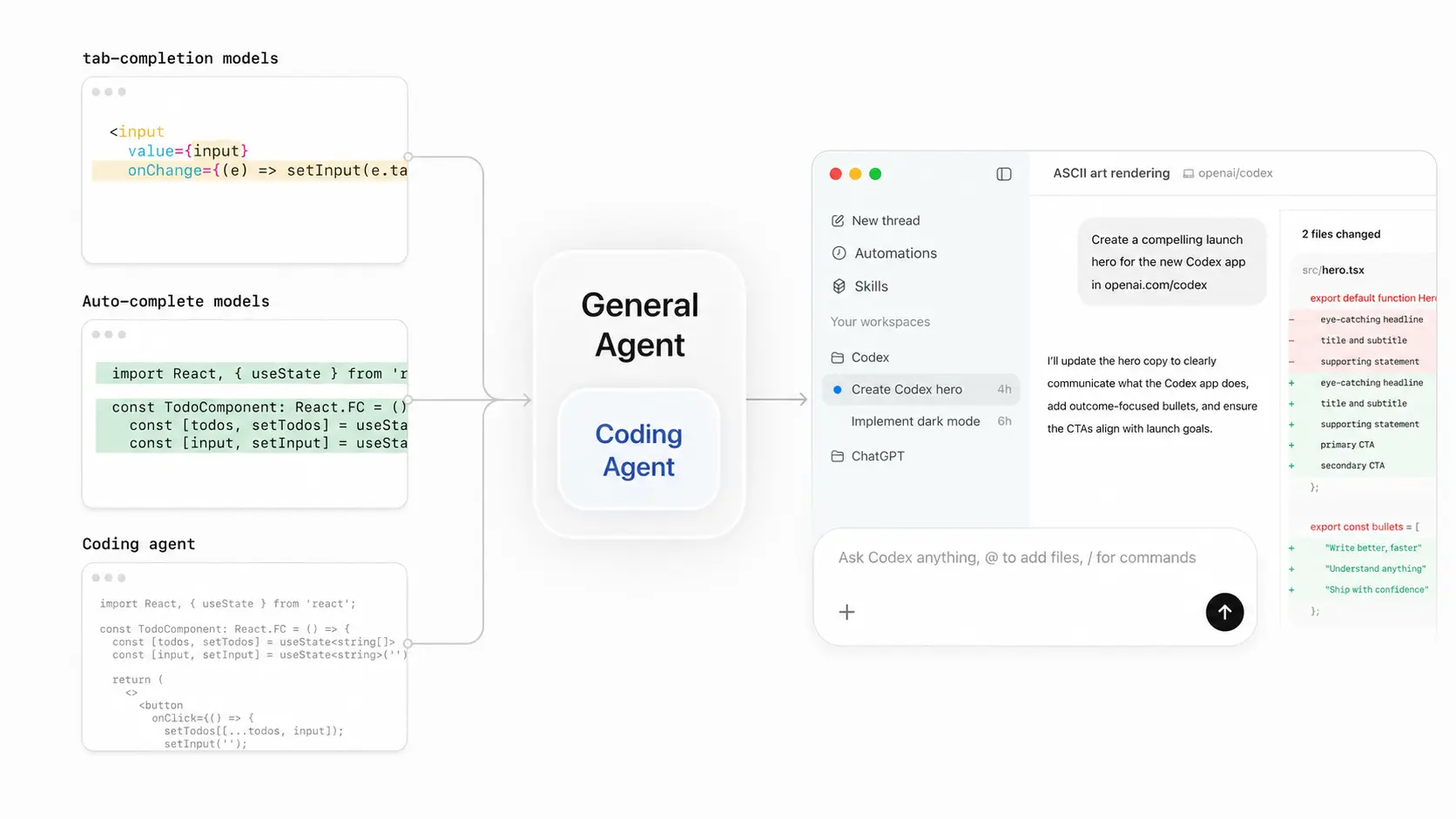
Coding agents did not become useful only because models got smarter. They became useful because software work already had the right environment for agents: Git, file diffs, terminals, tests, CI, APIs, credentials, and permission boundaries.
That harness let AI move from autocomplete, to editing a file, to understanding a repository, to fixing tests, opening PRs, and following the work through CI.
As a result, coding assistants started to feel less like typewriters and more like digital engineers.
The lesson is bigger than coding.
End-to-end work is where AI becomes valuable. As long as one link is missing, the user still has to spend several times more attention finding gaps, moving context, and patching the result.
Coding gave agents their first great harness. Bridge extends that harness to everyday work.
Introducing Bridge
We started Afk Inc. — Away from Keyboard — to build the execution layer for everyday life with AI.
Our first product is Bridge.
Bridge is not another chatbox. It is a lead agent for your work: a persistent AI that can see context, remember preferences, operate tools, coordinate sub-agents, and deliver finished results back where you need them.
It can work from its own computer, and with permission, it can also work across yours. It connects scattered tools and context so one request can become a completed task.
It can monitor new AI updates or stock prices online. It can dig through clues across your computer, cloud drive, Slack history, email, meeting notes, screenshots, and files. It can compare sources, summarize what changed, draft the reply, create the deliverable, and hand it back to you.
Humans mostly work serially. Bridge can pay attention to many sources and steps at the same time.
Screenshots, files, email, messages, apps, deliverables — handled in one flow.
Bridge gets better as it works with you.
It understands your preferences, routines, and context. It uses long-term memory to keep learning your work environment and habits. After complex tasks, it can summarize what it learned, preserve useful workflows as skills, and apply them again later.
Every finished task makes the next one easier.
Complete tool set:
Humans can only effectively control one mouse and keyboard at a time. AI does not have that limitation.
If the tools you use have APIs, Bridge can use them. If they have CLIs, Bridge can run them. If they have neither, Bridge can still operate the computer with you in control: opening apps, reading screens, clicking through workflows, and producing the result.
That matters because most real work does not live inside one perfect API. It lives in the messy middle between tools.
Bridge is built for that middle.
Just build and ship:
Bridge is the lead agent. Multimodal models, code execution, browser work, computer use, file handling, image generation, video understanding, speech understanding, and sub-agents can be orchestrated behind one request.
You do not need to learn a thousand different AI tools. You tell Bridge what you want. It chooses the path, does the work, checks the output, and returns something you can actually use.
With a single sentence, the best models can work behind the scenes to turn your imagination into an app, a document, a video, a research brief, or a workflow anyone can use.
You can even use Bridge to build other agents.
Save your attention for what matters
“Attention Is All You Need,” and the Transformer it introduced, gave machines a way to focus on what matters.
Modern work needs the same thing.
Your attention should be reserved for the decisions that truly matter: taste, judgment, relationships, strategy, care, and the few steps where only you can decide what is right.
But the past two years of agentic AI often made workflows more bloated. More tools. More prompts. More tabs. More outputs to inspect. More things to coordinate.
AI made us faster. Not always freer.
Bridge exists because the next leap cannot come from asking humans for more attention.
We need a new layer of attention — one that works on your behalf, follows through across tools, and carries work across the finish line with permissions, memory, and control.
Bridge is that layer.
A new source of attention for everyday work.